
ETF Trading: A DIY Investor's Guide
5/28/20264 min read
ETF Trading: A DIY Investor's Guide
Introduction
Exchange Traded Funds (ETFs) have become one of the most popular investment vehicles for investors seeking diversification, flexibility, and cost-effective portfolio management. Whether you're a beginner or an experienced investor, ETFs provide an efficient way to gain exposure to broad markets, sectors, commodities, and global economies—all through a single investment.
For DIY (Do-It-Yourself) investors, ETFs offer the freedom to build and manage a personalized portfolio without relying on actively managed funds. However, successful ETF investing requires understanding how ETFs work, selecting the right funds, managing risks, and maintaining a disciplined investment strategy.
In this guide, we'll explore everything you need to know to become a confident ETF investor.
What is an ETF?
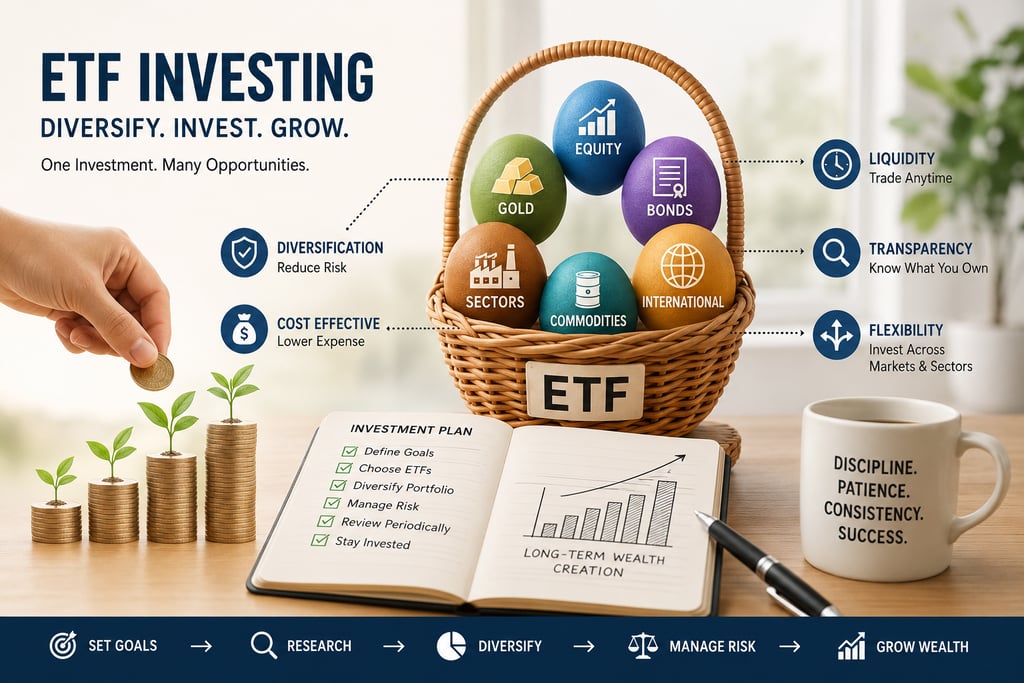
An Exchange Traded Fund (ETF) is a basket of securities that trades on a stock exchange, just like an individual stock.
An ETF may invest in:
Equity Shares
Bonds
Gold & Silver
Commodities
Real Estate
International Markets
Market Indices
Instead of purchasing multiple individual securities, investors can gain diversified exposure through a single ETF.
Why ETFs Have Become So Popular
ETFs combine the benefits of stocks and mutual funds, making them an attractive choice for long-term investors.
Key Advantages
Diversification
Reduce company-specific risk by investing in multiple securities through a single fund.
Low Cost
Most ETFs have lower expense ratios than actively managed mutual funds.
Liquidity
Buy or sell ETFs throughout market hours just like any listed stock.
Transparency
ETF holdings are generally disclosed regularly, allowing investors to understand exactly what they own.
Flexibility
Invest across sectors, countries, commodities, or themes using one trading account.
Types of ETFs
Choosing the right ETF begins with understanding the different categories available.
Equity ETFs
Track stock market indices or groups of companies.
Examples include:
Nifty 50 ETF
Sensex ETF
S&P 500 ETF
Nasdaq ETF
Suitable for long-term wealth creation.
Sector ETFs
Focus on a specific industry such as:
Banking
Technology
Healthcare
Infrastructure
Energy
Ideal for investors with a sector-specific outlook.
Gold ETFs
Provide exposure to gold prices without the need to purchase or store physical gold.
Benefits include:
Portfolio diversification
Inflation hedge
High liquidity
Bond ETFs
Invest primarily in government or corporate bonds.
Suitable for:
Conservative investors
Regular income
Portfolio stability
International ETFs
Offer exposure to global markets and help diversify beyond domestic investments.
Why DIY Investors Prefer ETFs
ETFs allow investors to take complete control of their investment journey.
DIY investing provides:
✔ Freedom to choose investments
✔ Lower investment costs
✔ Transparent portfolio management
✔ Greater flexibility
✔ Better control over asset allocation
However, with this flexibility comes the responsibility of conducting proper research before investing.
How to Choose the Right ETF
Not every ETF is suitable for every investor. Before investing, evaluate the following factors:
Investment Objective
Clearly define your goal.
Are you investing for:
Wealth Creation?
Retirement?
Regular Income?
Capital Preservation?
Your objective should determine your ETF selection.
Expense Ratio
Lower costs can significantly improve long-term returns through the power of compounding. Always compare management fees before investing.
Assets Under Management (AUM)
Larger ETFs generally offer:
Better liquidity
Lower bid-ask spreads
Greater market participation
Liquidity
Higher trading volume enables smoother buying and selling with minimal price impact.
Tracking Error
A quality ETF closely follows its benchmark index. Lower tracking error indicates efficient fund management.
Underlying Holdings
Always review:
Top holdings
Sector allocation
Geographic exposure
Asset allocation
Understanding what you own is fundamental to successful investing.
Building a Diversified ETF Portfolio
A balanced ETF portfolio reduces concentration risk while maximizing long-term growth potential.
Example Portfolio Allocation
Broad Market Equity ETFs
Gold ETFs
Bond ETFs
International ETFs
Sector ETFs
Cash or Liquid Investments
Your allocation should reflect:
Financial goals
Investment horizon
Risk tolerance
Liquidity requirements
Common ETF Investing Mistakes
Many investors underperform because of avoidable mistakes.
Chasing Performance
Past returns do not guarantee future performance. Avoid investing solely because an ETF has recently delivered high returns.
Ignoring Diversification
Holding multiple ETFs with similar underlying assets provides little diversification. Focus on meaningful asset allocation.
Frequent Trading
Constant buying and selling increases transaction costs and reduces long-term returns. Successful ETF investing is built on patience.
Ignoring Costs
Expense ratios, brokerage charges, and taxes all affect investment returns. Always consider the total cost of investing.
Investing Without Research
Before investing, evaluate:
Fund objective
Holdings
Risk level
Historical performance
Liquidity
Fund size
Research should always precede investment decisions.
Risk Management for ETF Investors
Although ETFs are diversified, they are not risk-free.
Effective risk management includes:
✔ Diversification across asset classes
✔ Periodic portfolio rebalancing
✔ Goal-based investing
✔ Long-term investment discipline
✔ Avoiding emotional decisions
Successful investing is not about eliminating risk—it's about managing it wisely.
Portfolio Review: A Key to Long-Term Success
Markets evolve, and so should your portfolio. Review your investments periodically to ensure they remain aligned with your financial objectives.
During each review, assess:
Asset allocation
Performance
Risk exposure
Sector concentration
Investment goals
Market conditions
A disciplined review process helps keep your portfolio on track.
Long-Term Wealth Creation with ETFs
One of the greatest strengths of ETFs is their ability to support long-term wealth creation through disciplined investing.
Combined with:
Regular investments
Diversification
Compounding
Periodic rebalancing
ETFs can become the cornerstone of a successful investment strategy.
Remember: Consistency often outperforms complexity.
ETF Investment Checklist
Before purchasing an ETF, ask yourself:
✔ Do I understand what this ETF invests in?
✔ Does it match my investment objectives?
✔ Is the expense ratio reasonable?
✔ Is the ETF sufficiently liquid?
✔ Does it improve my portfolio diversification?
✔ Am I investing for the long term?
✔ Have I evaluated the associated risks?
If the answer is "Yes" to each question, the ETF may be a valuable addition to your investment portfolio.
Conclusion
ETF investing offers one of the simplest and most effective ways to build a diversified portfolio. Whether your goal is long-term wealth creation, retirement planning, income generation, or global market exposure, ETFs provide flexibility, transparency, and cost efficiency.
At Investment Analytix Solutions, we help investors build research-driven portfolios tailored to their financial goals. Our disciplined approach focuses on diversification, risk management, and long-term wealth creation to help you invest with confidence.
Invest Smarter. Diversify Better. Grow Wealth Consistently.
Let’s talk about your investment goals.
investmentanlytixsolutionst@gmail.com
+91 6353803642
© 2025. All rights reserved.
Quick Links
Contact Us
phone